Showing posts with label MACRO Messages and Values. Show all posts

Wednesday, 21 November 2012

Textual Analysis MACRO framework definitions


Theory with a small 't' - some approaches
These critical approaches (theory with a small 't') may be helpful to explore your area - they are from A2 Media so the elders (yr13) may find this a good way to cross over with the Media exam


The Male Gaze


Thursday, 8 November 2012

V for Vendetta exam response exemplar (messages & values)

Thesis Statement
V for vendetta 2006 presents a dystopian vision of Britain in the near future where a corrupt and Fascist totalitarian government oppresses the citizens is challenged by a revolutionary Terrorist. The film's messages reflect the context of the early 21st Century the political and social unrest caused by the war on terror and 9/11. The film contains contentious and conflicting messages questioning the central character V's role as a both a Freedom Fighter and a Terrorist, and his motives condoning the use of violence for both personal revenge and to overthrow Fascism. Through the character of Evey the film makes the statement that the value of freedom is worth more than life, and that ideas are more powerful than the individual. Finally we are told that 'governments should fear their people' - that the rise of tyranny is the responsibility of the people's fear and willing dependency on government.


Theme: Terrorism
Scene: Opening
V's mask is based on Guy Fawkes and celebrates him as a freedom fighter. He blows up buildings and uses acts of terrorism. Opening scene with Evey
MICRO – locations (blows up Old Bailey = Justice), mask- guy fawkes, music builds up to an overture – his monologue is all about vengence
Message: Terrorism/violence is justified as a freedom fighter


Theme 2: Oppression
Scene: Dietrich's house/Evey breaks curfew
MICRO - has a copy of the Kohran (threat of Islamic beliefs), sex pistols style poster of Sutcliffe (Punk rebellion), a protest poster (Coalition of the Willing) homosexual erotic images (also the Lesbian character in the flashback is taken away for being gay)
He is 'black bagged' - taken away by the Secret Police like Eveys parents (Nazis)
Message: Facism = religious and sexual intolerance and restriction of rights of protest

Theme 3: Torture
Scene: Eveys is abducted, tortured and refusal to confess
MICRO – costume orange jumpsuits (Guantanamo), the small confined cell and shot in CU, her hair is shaved off – removing her femininity and fear/making her masculine and toughened, her rebirth is in the rain outside juxtaposed with images of Vs rebirth – one is fire, one if water (symbolism)
Message: Freedom is more important than the fear of death/Fear is a prison of your own making

Theme 4: Revolution
Scene: Ending
MICRO - The population are shot together as one united, Evey pulls the lever to blow up Parliament (so her choice), the dead characters are behind the masks – everyone is V
Message: When the people are united behind an idea of freedom it cannot be killed

or
V's Monologue Revolutionary Speech, uses Terror tactics to take over the TV station
Message: The people must take responsibility for themselves/not rely on government to protect them from Terrorism/take away their civil rights
 Theme 5: Vengence
Scene: Ending
MICRO - Evey pulls the lever NOT V to blow up Parliament the Revolution is no longer about vengeance but the decision is taken by a Free person/V has killed everyone in power but has his own selfish motives for revenge.
Message: Mixed messages - is the Revolution for Freedom or for his personal vendetta?         

Conclusion
The film uses the themes of Terrorism, Torture and Government Oppression to express the values of Revolution and a message that calls citizens to be vigilant and mindful of their governments in the face of the threat of terrorism. It also appears to condone the use of violence for political ends portraying the terrorist V as a freedom fighter and a hero even though he is motivated by vengance as much as he is freedom. The value of freedom is held greater than the life of the individual and the film communicates the idea that to be liberated from fear means to believe that the value of freedom is greater than personal safe or your own life – citizens ought to be wiling to die for this ideal. V for Vendetta addresses the conspiracies and fears surrounding the war on terror and the 7/7 bombings and 9/11, of governments using acts of terrorism to restrict of civil liberties and of protests.

Wednesday, 17 October 2012

Characters & Roles V for Vendetta

Dietrich - what is this character's role and what Messages or Ideas does his story communicate?

Mr Creedy - what is this character's role and what Messages or Ideas does his story communicate?

Prothero - what is this character's role and what Messages or Ideas does his story communicate?

Chancellor Sutler - what is this character's role and what Messages or Ideas does his story communicate?

We the People - what their role and what Messages or Ideas does their story communicate?

V - what is this character's role and what Messages or Ideas does his story communicate?

Evey - what is this character's role and what Messages or Ideas does her story communicate?

Wednesday, 10 October 2012

Examples of Themes & Values from a Disaster Movie

Link
  • Describe the Themes in V for Vendetta & identify key scenes for study
  • Apply a Thematic approach to the film using 1 or more MICRO
  • Analyse the Messages & Values in the film
Themes & Values in Disaster Movies example


Choose three-four scenes for micro & macro analysis. Scenes should be no less than five minutes and no more than 10 minutes long.


We will post some of our notes and discussions on this blog next week for further discussion and written analysis next week.

Example of MACRO analysis of Genre & Narrative in War Films

How to write an analysis (look at structure for how to write analytically)


Wednesday, 3 October 2012

V for Vendetta - Mock Exam Mod 1: Key Scenes for Analysis of Messages & Values

Section A Question 1
How are the key messages and values communicated in the films you have studied? [40/100 marks]

For questions set on the area of messages and values, candidates may offer discussions centring on the types of messages and values that can be interpreted from the texts selected for response and also discuss the processes by which these messages and values may be communicated. This may include discussions of one or more of the following:

Cinematography - the use of camera shots, angle, movement, composition, and lighting.

Editing - the organisation of sequences to construct meaning. This should include transition of image and sound, continuity and non-continuity systems, cutting (shot/reverse shot, eyeline match, graphic match, action match, jump cut, crosscutting, parallel editing, cutaway, insert).

Sound - diegetic and non-diegetic sound, synchronous/asynchronous sound, sound effects, sound motifs, sound bridge, dialogue, voiceover, mode of address/direct address, sound mixing, sound perspective, and soundtrack (score, incidental music, themes and stings, ambient sound).

Mise-en-Scène - production design, location, studio, set design, costume and make-up, properties, colour design, casting.

Key Scenes
Evey's Torture (Guantanamo, Rendition)


 Larkhill (GMO & Vaccines)


Ending (Revolution)


V's Speech (Suicide Bomber, Media Network)


Diettrich's Secret Life

V for Vendetta Messages & Values - Key Scene & Values

V for Vendetta
From the makers of The Matrix Trilogy, V for Vendetta paints the story of a vengeful terrorist – or freedom fighter? – which, whether in Thatcherite Britain of the 1980s or Bush’s America after 9/11, has an eternal message.
Philip Coppens

“Remember Remember the Fifth of November…” November 5 in Great Britain is notorious for being Guy Fawkes’ night. Fawkes was a “terrorist”, an English Roman Catholic who tried to blow up the Houses of Parliament in the so-called Gunpowder Plot in 1605. The now yearly fireworks that are held across the country are a somewhat mocking “tribute” to his failed attempts.
The plan called for Westminster Palace to be blown up during the formal opening session of the 1605 Parliament, in which the king addresses a joint assembly of both the House of Lords and the House of Commons. Fawkes’ activities were detected and following a severe interrogation involving torture and a trial, he and his conspirators were executed for treason and attempted murder. Fawkes became a national legend, whose actions continue to be remembered across Britain each year, and is thus on par with notorious Christian saints like St George or St Andrews and the Queen’s birthday. A man was transformed into a legend.
Guy Fawkes is central to “V for Vendetta”, which in origin was a comic book series that appeared in the 1980s, written by Alan Moore and illustrated mostly by David Lloyd. Though set in the future, it was meant to attack the then present premiership of Margaret Thatcher. The comic book series depicted the Norsefire, the archetypal “evil party” as Thatcher’s Conservative Party, based on fears of an extremist police state, which was notorious (e.g. the miners’ strikes). Norsefire obviously was also based on the Nazi Party, the example of a fascist regime par excellence. In both stories, thte Norsefire/Conservative Party actively participates in the systematic elimination of racial minorities, homosexuals and political dissidents from society.
The comic book was reworked into a film, with the film's original release scheduled for Friday, November 4, 2005 (a day before the 400th Guy Fawkes Night), but the release was delayed; it instead opened on March 17, 2006. Some believe it was postponed due to the July 7, 2005 London bombings, though producers denied this was the reason.
 

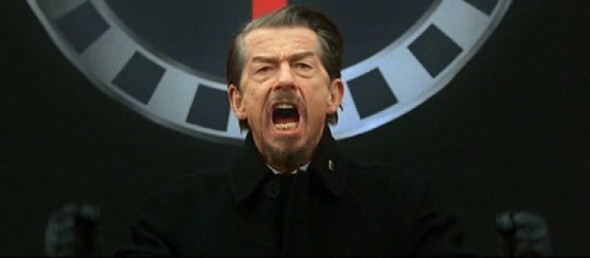
Apart from Portman and Weaving, there was also John Hurt in the role of High Chancellor Adam Sutler, a role virtually lifted from Orwell’s Big Brother. Playing Chancellor Sutler was a complete role reversal for John Hurt, as he had previously played the part of Winston Smith, the victim of the Big Brother state in the film adaptation of 1984

Fawkes is V’s inspiration. “V” wants to change the course of history by blowing up the Houses of Parliament – he wants to succeed where Fawkes had failed, and the date for this attempt is of course November 5. As to why he wants to do so: he wants to destroy the authoritarian government. V is a freedom fighter who uses terrorist tactics in pursuit of a personal vendetta but, above all, he wants to force socio-political change in a dystopian Britain. In the 1980s, Moore had used the future to paint 1980s Britain, the film used the future to paint, as one reviewer, the paint a "world where politicians lied to get us into an unpopular war [Iraq], one where torture is no longer considered off-limits by people who are supposedly the good guys, and where public surveillance is all but ubiquitous.” The film thus become notorious for one of its plethora of catchphrases: “People shouldn’t fear their governments; governments should fear their people.”
So the story is set in ca. 2038, when Britain is ruled by a totalitarian regime called Norsefire. It follows Evey (pronounced “E-V”) Hammond, a young woman who, at the start of the film, is rescued from the state police by a masked vigilante, who introduces himself as V and then sets out his “mission statement”: “Voilà! In view, a humble vaudevillian veteran, cast vicariously as both victim and villain by the vicissitudes of fate. This visage, no mere veneer of vanity, is a vestige of the vox populi, now vacant, vanished. However, this valorous visitation of a bygone vexation stands vivified, and has vowed to vanquish these venal and virulent vermin vanguarding vice and vouchsafing the violently vicious and voracious violation of volition. The only verdict is vengeance; a vendetta held as a votive, not in vain, for the value and veracity of such shall one day vindicate the vigilant and the virtuous. Verily, this vichyssoise of verbiage veers most verbose, so let me simply add that it's my very good honour to meet you and you may call me V.” To which Evey replies: “Are you like a crazy person?” V: “They will say that.” 

V takes Evey to a rooftop location to witness his spectacular first destruction: the Old Bailey, the “ouverture” to his year-long campaign. V has rigged the public address system, which is playing Tchaikovsky’s 1812 overture. The Old Bailey symbolises Justice and V feels it has to be destroyed, as Justice has taken a holiday and an impostor is ruling Britain. Of course, the regime explains the incident as a planned emergency demolition, with experts lined up to speak about a failed structural integrity of the building. The government claims that it was also blown up as evidence of Britain’s decadent past. 


But this is quickly shown to be a lie when V takes over the state-run television station (BTN) later that day. He walks into BTN as a suicide bomber, packed with explosives, and forces the station to play his prepared tape to the entire nation. V now informs the nation of his plan, urging the people of Britain to rise up and stand with him at the gates of Parliament on November 5, one year later. He implies that on that day he will destroy the Houses of Parliament. Though he is seen as a terrorist, V sees himself as a freedom fighter. He underlines that “the truth is that there is something terribly wrong with this country”. There is no freedom to object. The government is coercing your conformity. Who is to blame? Who is held accountable? Not the government, but the guilty, “us”. How did it get like this? “We were afraid. War. Terror. Disease, robbed us of common sense. Fear. And we turned to the Chancellor who promised peace, and to give us silent obedient consent.” Afraid of terror, we have allowed a terrific monster to be created: a totalitarian government, which hopes the nation will suffer from a collective form of amnesia. V wants to remind us of our past. “This country has forgotten something. Fairness. Justice. Freedom. They are more than words. They are perspectives. Stand beside me, one year from tonight, and together we will give them a fifth of November that shall never, ever, be forgotten.” He has laid down his challenge – and his agenda.
Within V’s liberation agenda, Fate then throws Evey, who works at the BTN and who the authorities believe is V’s comrade-in-arms, in the role of his accomplice. As Fate would have it, her parents were considered to be terrorists too. For the police, it is clear why she is doing it; as to V, and who he is, that is a major mystery. They are unable to comprehend that V is a human being; they depict him as if he has no human emotions. Still, “part of him is human”. It underlines how at the first, the police are totally unable to comprehend what motivates V; they see a man who breaks the law and nothing more. The police also search for a connection between V and Evey, but there is none. As to why V does what he does, this is only a slow realisation that the police make as his campaign progresses, before finally discovering that they should indeed be on his side. Meanwhile, BTN News makes it look as if the terrorist V was killed in a “heroic” raid that ended V’s siege of the BTN Tower – in reality, V escapes, and takes Evey with him. 

This episode also refers to one major difference between book and film: the computer system "Fate" is completely missing from the film. Fate was a Big-Brother-like computer which served as Norsefire's eyes and ears and also helped explain how V could see and hear the things he did. Of course, Fate’s presence would have made V for Vendetta very much into a Matrix clone. Instead, there are subtle references to the role of Fate (as in coincidence), with V indicating on numerous occasions that there is no such thing as coincidence, but merely the illusion of coincidence – suggesting an underlying plan – a greater scheme, hinting that V’s personal vendetta is not so much personal, but that perhaps he sees himself acting out a divine retribution, a notion not uncommon in terrorist – or government – propaganda.

Though Evey becomes V’s comrade-in-arms by Fate, we also see how V is not alone in wanting change. Evey finds rescue in the home of one of her superiors from the BTN, Gordon Deitrich (Stephen Fry), who reveals to her that he is a closet homosexual and a collector of banned art and literature. He has a copy of the Koran. He is not a Muslim (which, it is implied, has become outlawed), but he finds the book moving and interesting. Homosexuals too are outlawed. Though well-known and in the public eye, no-one knows him really. “You wear a mask for so long, you forget who you are beneath it.” This of course also applies to V. 

V is also a collector of art. Some of the works of art displayed in V’s gallery include "The Arnolfini Portrait" by Jan van Eyck, "Bacchus and Ariadne" by Titian, a Mildred Pierce poster, "St. Sebastian" by Andrea Mantegna and "The Lady of Shalott" by John William Waterhouse. V explains that “artists tell lies to tell the truth, while politicians use them to cover the truth up.” And it is clear that both the comic book and the film are artistic expressions. His personal motto is "VI VERI VENIVERSUM VIVUS VICI", "By the power of Truth, I, while living, have conquered the universe", taken from Faust, another “dramatis persona” upon which V seems to have based himself. He explains that symbols are important, as they are given power by the people, whether it is the Houses of Parliament, the Old Bailey… or Guy Fawkes. Still, V hiding behind a symbolic mask is used by the government to make ridicule of him: “A man does not wear a mask. A man does not threaten innocent civilians. He is a coward.”


The year-long campaign that V has set out is a killing spree, a personal vendetta, whereby each murder has to be explained away by the authorities, but whereby each murder helps the police paint the truth: that V is doing this spree as it is his personal vendetta.
One by one, leading social figures are killed; there is the murder of a paedophile bishop. There is Lewis Prothero, the “Voice of London”, who “died in his sleep”, rather than in the shower, where V kills him. As the killing spree continues, the trail becomes clear, and involves another V: Viadoxic Pharmaceuticals. It operated a site known as Larkhill, where fourteen years earlier, the company had made a discovery that “could be the dawn of a new age”. The facility is described as the end of atomic, but the start of biological warfare. What no-one knows, is that the agents are tested on humans, which the scientists involved describe as “weak and pathetic” people, “helping” their country. This is where V’s role comes to the forefront. One night, one November 5, the facility was hit by a series of explosions. It turns out that only one person survived: V. He stayed in room 5 – V – and not only is he the sole survivor, it also seems that he was the person who created the explosions, a skill he has also used on the Old Bailey and will use on the Houses of Parliament. 


But that is not all: the leaders of Viadoxic were also the ones who created the totalitarian regime. The ultra-conservative Norsefire party played upon the deeply divided country, trying to gain in power, until a bioterrorist attack occurred, killing 80,000 people. The fear generated by the attack allowed Norsefire to silence all opposition and win the next election by a landslide. A cure for the virus was discovered soon afterwards. But rather than return to a state of peace and freedom, fear was used to turn Britain into a bigoted totalitarian order, with their leader Adam Sutler becoming the High Chancellor.


The entire nation, fourteen years onwards, still lives under the notion that it was a biological attack by a terrorist, but V knows better. The question he poses is what if the worst most horrific biological attack was not the work of religious extremists? (Who were, by the way, executed for it.) What if someone else unleashed the virus and someone else killed all of these people? He asks “Would you really want to know who it was? If it was someone working for this government? If our own government was responsible for the deaths of almost 100,000 people. Would you really want to know?”
The police figure out V’s motive just before the murder of a doctor who was involved in the Viadoxic experiments and who apologises for what they did to V, but V remarks that “I have not come for what you hoped to do, I have come for what you did.” Though the doctor wanted to do differently, she did it just the same.
Only the top echelon of the party, all guilty of the crimes committed against V and the loss of freedom in Britain, now survive. They are trying to stop the police’s Larkhill investigation, by questioning the loyalty of the investigating chief inspector: the contents of the documents are made subject to national security and at the same time put in doubt. They are described as a possible forgery created by the terrorist himself, or a delusion of the writer. Either way, it would be an act of treason if their contents were divulged. “You would do well, inspector, to put it out of your mind.”
A key sequence is when Evey thinks that she is captured by the police, incarcerated and tortured for days, finding solace only in the notes left by another prisoner named Valerie, who was imprisoned and persecuted for being a lesbian. Evey is told that she will be executed unless she reveals V's whereabouts. An exhausted Evey finally says she would rather die, and, surprisingly, is then released. Evey discovers that she has been in V's lair all along, and that her imprisonment was staged by V. By forcing Evey to experience what he had gone through long ago, V hoped that Evey would understand that our integrity, "the very last inch of us", can be more important than our lives. She is now rid of fear, not afraid of dying; she is truly liberated; she has, like V, become “superhuman”. At this point, V reveals that Valerie was the spark of his rebellion and hatred of the government. V tells her that she hates him now for what he has done to her, but “then something happened, it happened to me, just like it happened to you.” V created a lie, but because she believed it, she found something true about herself. “This is the most important moment of your life. Commit to it.” It is here that there is a graphic representation of her rebirth: she receives a baptism of water (rain), interspersed with flashbacks to V's rebirth, when a victim in a cruel pharmaceutical experiment liberated himself, and via a baptism of fire, was reborn as V, heralding a twenty year long vendetta, which is supposed to lead to a new world.
As November 5 nears, V's various schemes cause chaos and the population grows more and more intolerant and subversive towards the regime. The TV pump up the ante and fear, to underline that obedience is required against the danger that is everywhere. There are references to civil war in the United States; water shortage and water coupons; avian flu; quarantaine zones and airborne pathogen, while the terrorist V is linked with an attack on London 14 years ago. The government is trying to maintain the status quo of fear and showing that revolt will lead to severe consequences.
On the eve of November 5, Evey is shown a train in an abandoned London Underground station which V has filled with explosives in order to destroy Parliament. He leaves the decision up to her and leaves to meet Party leader Creedy who, as part of an earlier agreement, has agreed to bring the Chancellor to V in exchange for V's surrender. Creedy kills the Chancellor in front of V, but rather than surrender, V also kills Creedy. During the fight, Creedy asks: “Why won’t you die?” “Beneath this mask is an idea. And ideas are bullet proof.”
V the man, however, is mortally wounded in the fight, but returns to Evey, thanks her, professes his love for her, and dies. His body is placed upon the train with the explosives, his funeral barge, which Evey, with the consent of the chief inspector, sends towards the Houses of Parliament. Meanwhile, thousands of Londoners, all wearing Guy Fawkes’ masks, march on Parliament to watch the event. Because Creedy and the Chancellor are dead, the military receives no orders from superiors and, as a result, stands down in the face of these riots, preventing bloodshed.
Remarkably, the final scene, incorporating Westminster, the area from Trafalgar Square and Whitehall up to Parliament and Big Ben, was actually shot on location. The area had to be closed for three nights. This was the first time the security-sensitive area (home to 10 Downing Street and the Ministry of Defence) had ever been closed to accommodate filming. Furthermore, Prime Minister Tony Blair's son Euan worked on the film's production and is said (through an interview with Stephen Fry) to have helped the filmmakers obtain the unparalleled filming access. This drew criticism for Blair from Conservative MP David Davis due to the controversial content of the film. However, the makers of the film denied Euan Blair's involvement in the deal, stating that access was acquired through nine months of negotiations with 14 different government departments and agencies.
The Houses of Parliament is destroyed by the explosion amid the 1812 Overture. On a nearby rooftop, Evey and chief inspector Finch watch the scene together and hope for a better tomorrow – a real hope, not like the one that would turn an atomic into a biological war. Earlier, V illustrated that Victory was a perilous event, for it would be a domino-effect, illustrated by V playing with dominoes, in which one action leads to a next step, each increasing the former, until a crescendo is reached and the final domino does or does not fall… But in the end, the reVolution was successful.
V is dead; his vendetta has wiped the slate clean; a new world will dawn tomorrow, a new Britain can be built. V is now no longer for Vendetta, but for Victory. But in the end, V is also for loVe; though V’s actions will have major political consequences, in the end, he was also a man, and his motives were not purely for the greater cause, but also because he had suffered as a man. “A man can be killed and forgotten, but 400 years later, an idea can still change the world. […] Ideas do not bleed. They do not feel pain. They do not want love. But it is not an idea I miss. It is a man.” V.

V for Vendetta Messages & Values 2 - Categorise

There's no mistaking the political statement in V for Vendetta, in which the hero is also a terrorist.


By Steve Persall
Published March 16, 2006


V for Vendetta is the boldest political statement against the Bush administration since the 9/11 terrorist attacks. Even Michael Moore wouldn't prescribe bombing government facilities as a cure for dubious leadership. A futuristic setting in England doesn't disguise the film's rabid intent.
James McTeigue's movie will be branded as irresponsible, even dangerous, by some viewers, although if the past in any indication, the ones who don't see it will yowl loudest. All those knee-jerk critics need to know is that the film's hero is a terrorist.
V for Vendetta audaciously proposes that one man's terrorist is another man's freedom fighter, and the difference between good and evil is mostly semantic.
The film is based on a graphic novel written by Alan Moore and illustrated by David Lloyd; the book was released in 1989 to protest the political atmosphere of the Margaret Thatcher years.
The plot has been reworked to post-9/11 sensibilities by Andy and Larry Wachowski, who wrote their first draft before The Matrix made them famous. Alan Moore has distanced himself from the production; an adapted dud such as The League of Extraordinary Gentlemen can make an author skittish.
Or perhaps he guessed a firestorm lay ahead and didn't want to answer for other authors' ideas. The Wachowski brothers are notoriously reclusive, making this a cut-and-run protest of sorts. V for Vendetta will reignite those claims of disconnect between the film industry and the real world that George Clooney eloquently doused at the recent Academy Awards.
The movie begins with a flashback to 1605 when Guy Fawkes unsuccessfully conspired to blow up Parliament, and was captured and executed. "Remember, remember, the fifth of November,'' the poem begins. But people have forgotten by 2019 when a mysterious figure wearing a cape and eerie Fawkes mask plots an explosive reminder.
Hugo Weaving "Agent Smith'' in the Matrix trilogy wears the mask throughout the film, yet his elocution of the Wachowskis' rich, rebellious dialogue creates a fuller character than expected.
He calls himself V, explained with delirious alliteration to Evey (Natalie Portman), whom he rescues from a trio of lecherous government goons. V takes Evey to a rooftop to witness his masterpiece, blowing up the Old Bailey courthouse on Nov. 5, 2019, to protest a totalitarian regime. She becomes his accomplice, both pursued by grim inspector Finch (Stephen Rea). V vows to complete Fawkes' mission and blow up Parliament on Nov. 5, 2020.
The screenplay stacks the cards in V's favor, with vaguely familiar polemics about strength, unity and faith in God spouted by blustery Chancellor Sutler (John Hurt) and a TV commentator ranting like Bill O'Reilly. Color-coded curfews keep dissent down; the media is a spin-control tool; and a Ministry of Objectionable Materials hides books, works of art, even a jukebox from citizens. Possessing a copy of the Koran is reason for execution, lumping Muslims into the same undesirable group with homosexuals and anyone who disagrees.
"The security of this nation depends upon complete and total compliance,'' Sutler says, and we're urged to hiss.
Such words speak much louder than violent actions in V for Vendetta. This is a film about ideas, not entirely popular ones, that could topple a government faster than bombs if enough people took them to heart. The finale of McTeigue's movie, when V's vendetta spreads to the masses, is so revolutionary that I wondered how this movie ever got made, much less distributed by a major studio (in this case, Warner Bros.).
Does it endorse terrorism? Not as much as it decries politicians using fear to rule. More semantics. The future, the film loudly declares, is now.

V for Vendetta Messages & Values - Characters & Values

V for Vendetta


The Man 

V, is, in even the loosest definition of the word a terrorist. Is one man's terrorist another's freedom fighter? I would normally say no. The two are different. A terrorist targets civilian targets to create un-rest in support of an idelogical goal. A freedom fighter has a specific greivance and often seeks to gain land or territory, some tangible, usually feasible, goal. So which is V? V is, in fact, both a terrorist and a freedom fighter.

We never see V's face. This is very important, as Evey realizes at the end. She can remove his mask, if she chooses. Indeed, part of her wants. But she chooses not to. Why? She realizes that to remove his mask would be to humanize him. V is not a human. He is an idea. This is key. As he states, "Ideas are bullet-proof." An idea cannot be killed, it can only be replaced by a better idea.

What idea is V? What does he stand for? He values culture, the arts, the films and the music. When Evey says that she is nobody, he corrects her. Everyone is somebody. So he values human life. Yet, he takes it so callously. How is this possible? Because V values certain things more than even human life. Namely, Freedom and Truth. These are his ideas.

The Vendetta 

V, at first, appears to be on a personal vendetta against those that wronged him. The suffering he endured in the concentration camp. He escaped. He seeks vengenance on the principle of the thing, the idea. So, he sets out to kill those that wronged him. Then, he proceeds to dismantle their governemt. His vendetta is not against his personal villains, it is against them, their ideas, their symbols, and the institutions that supports them. It is a vendetta, a personal one, against an entire idea.

To complete his goals, he murders those that have wronged him. He blows up their buildings, their symbols. He destroys their institutions, and ultimately, he replaces their ideas with his. All of these must be completed, even after the leader is dead, he still destroys Downing Street, for example.

The Fascists 

Our antagonists are un-abashed fascists. The are Nazis with a different symbol. The Nordic party, for god's sake. The Fascists value two things: Order and Survival. The Order of their society and the Survival of their society. They, unlike V, have no value of human life. They believe the ends justify the means. Thus, to ensure the survival of their society they wipe out all dissidents and all elements that might oppose them with concentration camps and secret police. Susan, the leader, has one love: Fate. We can assume then, that V might represent the opposite of Fate-Free Will.

The Death of an Idea 

V must kill their idea with his own. How? This was perhaps the most startling part to re-discover upon a re-read. V captures Evey and tortures her and beats her and locks her up. Why? To set her free. Freedom has nothing to do with a physical body. She becomes free when she decides that she values her personal identity over her own life. When she refuses to betray V, she becomes free. The change happens only in her own head, to be free is entirely a state of mind. The people willingly put themselves in cages out of ignorance. The people are in charge, always. If the government can cow them into thinking that they are oppressed, then so shall they be. When V shuts down the cameras, when the people begin to riot and over-throw, V has simply shown them that they are free. Now, when the government tries to subdue them, it will likely fail. They are free now, or at least on the path to it.


Evey
 Or as she is more commonly refered to as Eve, aka the first woman, the woman to give birth to the rest of society. The Mother of us all. When we first meet Eve, she is meek and childlike. She attempts prostitution, sleeping with her boss to maintain her job at the TV station. This tells us something, in the beginning her main concern is on survival and money, but mainly survival, as money is simply a means to that end. Similiar to the fascists, she believes the most important part of a person's life is to stay alive at all costs. V takes her under his wing. To be honest, Eve is a confused young woman, part of her wants him to be her father. She is looking for a male figure in her life. After V leads her out and lets her go, as one would an animal or a small child, she becomes attached to a middle aged man. A nice man who lets her stay at his place. Here, she finds something closer to what she thinks she needs. He is at first a father figure, someone to replace her father she lost when she was young. Before he dies, they two briefly ponder the police state they live in, if only life was better....  And then V captures her. And sets her free.
Now, Evey at the end of the novel is very different. When V dies, she is imagining the face under the mask. Her father? Her lover? No. Her face. She realizes she doesn't need the support or help of any male figures in her life. With V gone, she finally becomes a fully self-sufficient person, and assumes the creator portion of anarchy, as V intended all along. As this creator figure, she has no concerns for money or survival as she did at the beginning.

"By the power of Truth, I, while living, have conquered the universe"As V has this quote engraved on his hide-out, it is apparently extremely important to him. This fits with his two ideas, Freedom and Truth. If one were to believe in this saying, it would follow that with nothing but Truth, one can conquer any obstacle. Remember V's destruction of the fascist's ideas with his own.
The second part of this section is to whom he attributes the quote to. A certain Dr. Faust. Dr. Faust, who sold his soul for knowledge. As V seems to support this quote, he apparently believes that Truth is more important than even one's own soul.
And finally, we consider the allusion to Faust V makes to the deal Evey wanted to make with him. Is V comparing himself to the devil, and Evey to Faust? This would fit with V's earlier description of himself as the villian of the story.

Wednesday, 19 September 2012

Messages (Ideology) in Film

What is Ideology? 
To break down ideology in film, we must first discover the definition of ideology.  As Louis Giannetti says in Understanding Movies, "Ideology is usually defined as a body of ideas reflecting the social needs and aspirations of an individual, group, class, or culture. The term is generally associated with politics and party platforms, but it can also mean a given set of values that are implicit in any human enterprise -- including filmmaking.”  In other words, pointing more towards film, ideology can be known mainly as “assumptions.”  It can be imagined as a way of looking at things or simply, as a "comprehensive vision."  Ideology pushes against already existing conformity by presenting a possible transformation in society.  This is done during a regulartory process of abstract thoughts.  As in the Wall-e picture to the right used in K-Punk's blog called
Robot Historian in the Ruins he says, "Ideology is not something foreign, something in a film with a strange power to impose itself on our minds; ideology is what we and the film share, what allows for the transfer of specific meanings between film and audience (a transfer which is not one way)."


Ideological viewpoints and principles detach from our own personal self-image.  They are usually discovered at an unconscious altitude and therefore, are not frequently observed.  With this said, although it is sometimes complex to understand how the personal riddle of ideological-ness works, it is valuable to understand how the individual reacts and perceives something at an unconscious thinking level.  It is also valuable to explore ideological ideas and attitude of others.

Wednesday, 12 September 2012

Themes and Messages - Dystopia Terminator/Metropolis/Wall E

Technology: The Rise and Fall of Cultural Fear


As Isaac Asimov tells us, 'modern science fiction is the only form of literature that consistently considers the nature of the changes that face us, the possible consequences, and the possible solution.' Most definitions of sci fi reflect this notion: a hypothesized prediction of our future, based on what we have already done or learned in science.

Societal Fear

The Terminator films rely on two major themes: advanced technology and societal fear. These themes compliment and rely on one other. Perhaps the most obvious fear that can be seen in Terminator II is the connection with the historical context within the plot of the film. When the vicious computers became powerful enough to take over the world, the historical content within the plot of the film. When the vicious computers become powerful enough to take over the world, they do not simply emerge and start attacking; rather, Skynet launches a strategic military attach on the former Soviet Union, starting a chain reason in which they predictably fire nuclear weapons back at the United States, starting a third world war that is chemical, fatal, and the end of humankind as it has been known. (The most obvious connection here is to the cold war).
Another major fear of 1990s society is the fast paced movement of technology that we have all felt and arguably still feel now to varying degrees. We all feel it in some way or another. Science Fiction, like distopian literature, is littered with such fears and moral dilemmas. Is it our dependence upon the machine, the computer, the advanced mechanical world essentially, that makes us vulnerable to such a valid fear? We depend upon so much computer technology for our every day existence, that perhaps we are afraid of the consequences when we may someday go too far. Thus, the very idea of films such as Terminator 1 & 2, The Stepford Wives, Blade Runner, Total Recall, Demon Seed and the like. They play upon our fears and our dependency of/with technology.

Technology / Creation VS Creator

There is an existing debate over whether so much technology, computer and otherwise is good or bad. Few could argue that the creation of the atomic bomb is bad, just as the creation of carious computer aided medical equipment is good. However, there is an entire area of grey (of which we have already started to discuss elsewhere in forums) and which is much larger and much harder to define as simply good or bad. Yet no matter how sceptical, we are still fascinated, intrigued , and interested in technology. However, the moral responsibilities of science or the scientist to both their creation and to society is still a remaining (and frequently asked) question. As we will see later in the Course, Mary Shelley and others have illustrated this in works such as Frankenstein; the idea of the scientist, obsessed with the notion of new direction, advancing technology, etc., creating new things without regard for the moral consequences of their actions. This is precisely what happens in the Terminator movies. As Sobchack points out: Terminator II refuses to accept the unsettling consequences of the cyborg in the name of instrumental domination in the realm of technology.
Thus we arrive again at the popular motif/ real fear of the creation surpassing its creator. Consequently, the voice over at the beginning of Terminator II states: 'three billion human lives ended on August 27, 1997. The survivors of the nuclear fire called the was Judgement Day. They lived only to face a new nightmare - the war against the machines' (Terminator II, opening scene).
Technology is moving toward creating machines that will surpass us in strength, agility, and even intelligence. When this happens will we still be able to control it? Karla Jennings discusses the creation turning on its creator in The Devouring Fungus:
From the moment the German Metropolis unveiled the first gleaming cyborg, it has had a place in fiction as a creation both beautiful and evil. Made more perfect than the most flawless human, it's an avenging angel bent on murder and almost impervious to be destruction. It reached its gory glory in The Terminator, where Arnold Schwarzenneger is as skilled at massacring humans as doing home eye surgery.(200)
Jennings points out that the word 'robot' was invented by Karel Capek, who took it from the Czechoslovakian word for servitude or forced labour. She argues that we view the computer and its evolving technology as a 'growing' but 'unnerving' machine, adding that 'The computer isn't to blame for reflecting our fears, we are' (20).
Sherry Turkle also addresses the notions of creator and creation: She explains how a learning programme played checkers according to built in rules, and a built in programme which taught it to modify these rules based on experience. Eventually it played against the best in the world and won. However, as Turkle points out, 'the dramatic moment in this programme's life was not the day it bear a champion, but the day it bear its creator. The programme became good enough to bear Arthur Samuel (its creator) at his own game.' (278). Consequently, Norbert Wiener suggests that the implications borders on the theological: 'Can God play a significant game with this own creature? Can any creator,. Even a limited one, play a significant game with his own creature?' (279). Turkle then argues that for Wiener, 'the working of the Samuel programme started to feel like overstepping an ancient taboo: the taboo of speaking of 'living beings and machines in the same breath' (280). Why is it taboo to use such terms together? Turkle argues that it is not surprising:
The vehemence of response and expresses our stake in maintaining the line between the natural and the artificial, between human and the mechanical. Discussion about computers becomes charged with feeling about what is special about people: their creativity, their sensuality, their pain and pleasure.
And how do we feel when the cyborg is faster than us, stronger than us, more advanced than us? We fear that it will usurp our power-perhaps the most valuable thing we pride ourselves in having.
Indeed, we have seen much movement towards human vs the human like machine-the cyborg. Yet there still remains a belief that there is something special about humans that could never be replicated into a machine. Turkle says that,
The connection between artificial intelligence and the 'meta-physical computer' is apparent. As soon as you take seriously the idea of creating an artificial intelligence, you face questions such as whether we have any more than sentimental reasons to believe that there is something about people that makes it impossible to capture our intelligence in machines. Can an intelligence without a living body, without sexuality, even really understand human beings? (19-20)
The relationship between human and cyborg is a complicated one. The paradox which exists is one that where human rejects machine, they also yearn for its advantages, and vice versa. In science fiction, the inventions of cyborgs, artificial intelligence, computers and the like, may be rooted in the science, but they work in the fiction because of our ideas about the future of such technologies. We need not know the particulars of A.I. advances, or the complicated reasons why certain technologies do not as of yet work. Rather, all we need know are our 'ideas' about such things.
Turkle explores what happens to people when they come to think of their mind as a programme and in turn as themselves as machines. This sort of investigation is a common one amongst many science fiction stories: the human and the machine: separate, yet inseparable. In our vast moving world of technology, the distinguished line between human and machine has become blurred and thus frightening. As we have already seen in Haraway, there is
a leaky distinction is between animal-human (organism) and machine. [earlier] machines were not self-moving, self-designing - they could not achieve man's dream, only mock it. They were not man an author to himself, but only a caricature of that masculine reproductive dream. To think they were otherwise was paranoid. Not we are not so sure. Late twentieth century machines have made thoroughly ambiguous the difference between natural and artificial, mind and body, self-developing and externally designed - our machines are disturbingly lively, and we ourselves frighteningly inert. (Haraway 579)
The cyborg in Terminator I, is innately arguably evil and inhuman. He is a machine who is called upon to perform a task; he is programmed to kill Sarah Connor and stops at nothing to achieve this. However, in the second film, this same machine learns human qualities. Although programmed to protect rather than stalk, the cyborg deviates from his specified task and learns the value of laughter, speech and finally, of human life. Like Star Trek: The Next Generation Data, he wants to be more human. He wants to fit in with the humans he has come to seemingly 'care' about and understand their feelings, etc. Envious of man's unique qualities, the T101 adopts human characteristics. But, 'the T101's, humanity' is at once superficial and artificial - a layering of organic material over a 'heart' of metal and circuitry' (Sobchack 7). Consequently despite the terminator's will for human qualities, it is this machinery at the core of the cyborg that determines the fate of its existence. As Sobchack notes: 'The Terminator is unable to shake free the machine at the heart of him' although he develops the semblance of a personality. At the end of the film he is still radically differentiated from the human: crying 'is something he can never do' (8). A similar argument can be made for the humans in the film. Although frightened by the possibility of 'being controlled', humankind in Terminator II, not unlike our own world, is obsessed with creating bigger and better machines. Further, some characters themselves not only become obsessed with the power uniquely attributed to the machine, but adopt machine-like qualities.
Sarah Connor is obsessed with the machines of the future.  She is committed to Pesatgero, an asylum for the mentally insane, because of her obsession and irrational fears of the machine (she tries to blow up cyberdom).  She not only becomes addicted to her thoughts of the machine, but in fact, becomes addicted to her own fear.  She is frightened of the future, dreaming of burning bodies, etc., yet she is obsessed with and cannot reject the idea of the machine.  Sarah Connor learns to ignore her human nature, showing compulsive behaviour as she teaches herself and her young son military tactics.  She eagerly builds a fortress of weapons and killing equipment to protect herself against the evil machines of the future.  Indeed, she seems *programmed* with a task in the same way that the cyborgs do.  She stops at nothing to prepare herself and her son, even continuing to fight for her freedom while incarcerated.
Connor begins to disregard all other aspects of her life, and instead turns to thoughts of the future. In the film, John explains that her last boyfriend was a green beret who ran guns, and that she 'would shack up with anyone she could learn from so that she could teach him how to be this great military leader' (Terminator II). Skynet is her only thought as she arms and prepares herself. She cannot stop herself from her addiction. She becomes cold and emotionally distanced from her former human compassion. Lost in her obsession, she eventually believes she can kill as coldly and mechanically as the Terminator itself. Connor's obsession can be most powerfully attributed to her fear (and thus society's own fear), of being mastered. Historically it is man or humankind who has mastered and controller lesser creatures. However, the computer is in most instances seen as an equal or superior 'creature'. Turkle argues that it is this concept of mastery that fascinates or addicts the hacker to the computer: Hackers use their mastery over the machine to build a culture of prowess that defines itself in terms of winning over even more complex systems. And it talking to personal computer owners I heard echoes of the search identity. I found that for them the computer is important not just for what it does but for how it makes you feel. It is described as a machine that lets you see yourself differently, as in control, as 'smart enough to do science', as more fully participant in the future. (20) In fact this is a significance in plot for both Terminator films and hackers, searching to break down the system of the undefeatable Terminators. In Terminator I, Sarah and Reese strive to outsmart the programmed cyborg and defeat him rather than be defeated. In Terminator II, they strive to outsmart and master the machine culture of Skynet as a whole. Their goal is to reprogramme the future so that the culture of machines will never exist in the first place, thus regaining control and becoming master over their own destiny. They fear the exact opposite; that the computer culture of Skynet will master the human race to the point of extinction (through execution). It is their fear of the more powerful machine, as well as the notion of losing control, that urges them on to conquer. Similarly, as Sobchack points out, John Connor discovers that he is superior to the T101 cyborg in Terminator II, when he discovers that he has control over him. 'Cool', says John 'my own terminator'. This control is crucial for John and all humans in the struggle to master the machine: 'this modernist logic in Terminator II has as its correlative the demand for 'instrumental' control of technology, and that it further accepts the impassibility of clearly distinguishing between humans and machines' (qtd. In Sobchack 11). Sobchack argues that the film operators through as dichotomy of the controlled/uncontrolled, as it moves from the present in which the machines are controlled by humans, to a 'dystopic future' which threatens not only its audience but its characters. She says that 'opening sequences portray a future in which machines dominate a landscape littered by human remains: It is under this logic that the T-1000 becomes so threatening' its continually taking on of new shapes allows it to elude human control (the T-1000 repeatedly escapes confinement, for example, by 'pouring' itself through small gaps) (Sobchack 9).

Consider the following questions:

  • What is it that makes Blade Runner and the Terminator films scary? Do you find the lack of emotion in the replicants and the T100 and T800 cyborgs to be frightening? If so, why? If not, why? In our current cultural climate, what is it (if anything) about technology itself that is frightening in these films?
  • Blade Runner addresses significant issues of morality, emotionality, and the concept of truth. Which of these do you find to be more difficult to 'settle' in your mind? Indeed, can they even be seperated? What parallels do you see with The Terminator or Terminator II: Judgement Day?

You may take these as rhetorical questions to ponder yourself as you make your way through the material, or, if you wish, you may make an entry in your General Journal or The Gendered Cyborg Forum. Keep in mind that all contributions to questions such as these are preparatory for your final essay. In other words, the more hard thinking you do throughout the Course, the more prepared and the more material you will have when it comes time to do your final assessment.

References

Beeler, Stan W. The Invisible College: A Study of the Three Original Rosicrucian Texts, (New York: AMS, 1991).
Gokce, Neyir. 'Definitions of Science Fiction' from http://www.panix.com/~gokce/sf_defn.html (last accessed March 12 2005).
D. Haraway, 'A Manifesto for Cyborgs: Science, Technology, and Socialist Feminism in the 1980s' in Gill Kirkup, Linda Janes, et al. (eds), The gendered Cyborg. (London: Routledge 1984).
Jennings, Karla. The Devouring Fungus: Tales of the Computer Age, (New York: W.W. Norton & Company, 1990).
Sobchack, Vivian. The Carnage of Identity: Cyborgs and Women in Science Fiction and Horror Film, from http://vioelt.berkeley.edu%7Erollins/cyborg.html (Feb 10 2005).
Turkle, Sherry. The Second Self: Computers and the Human Spirit, (New York: Simon & Schuster, 1984).

Wednesday, 5 September 2012

What is Film Studies - Messages & Meanings

Hollywood Action films - What hidden meanings behind these films?


Assessment for Learning
In the Style of Batman...
Xtranormal film presentation discussion  http://www.xtranormal.com/xnmm/edit_movie/?actors=2&collection=sbg
Superhero one...
Think about camera angles
How the actor will perform & move & facial expression

http://www.youtube.com/watch?v=7Ddeqre8z7M 1min - 1.27