Showing posts with label Coursework. Show all posts

Wednesday, 27 February 2013

Film Studies Final Deadlines Reminder


Remember - Failure to hit these Final deadlines results in a 0 mark

This week
Friday 1st March  
Location Report with series of Photos
&
Final Script with annotations of 9 Shot Type and explaination

End of Module 4 (4 weeks)
Thursday 27th March 
Final Submission of Textual Analysis (Essay 1500 words or 8-10 min presentation)
&
Final 9 Key frames- posed & in costume, set dressed/location, shot type

1st wk after Easter (7 weeks)
Friday 19th April - Final Evaluation

All work to be submitted through your group Blog

Wednesday, 13 February 2013

Homework for Half Term - Planning & Creative Artefact


Final Deadline - 1st March
1. Planning
Location Report (a series of photographs with notes on suitability to the scene & aesthetics (the look)
Present this as a NEW Blog Page customised to look like a 'Film Location Report' blog page to contain your Report & your Photos Example

Your Report requires notes on... 
  • Transport links/how accessible include a Google maps/Streetmaps image
  • Who is the contact for the location and arrangements for using their site
  • Health & Safety concerns for your production/scene
  • Lighting & Noise, Electrical Power
  • Evaluate - how suitable to what you want it to look like on screen/what happens in the scene: set dressings required etc.

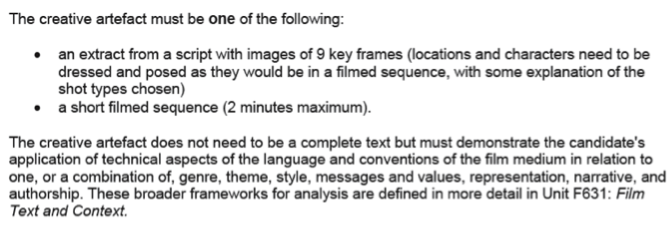
2. Creative Artefact (Script with 9 Key Frames & annotations on shot types)
Uploaded to your Location Report Blog & Labelled as 'Creative Artefact' with:
  • 9 key frames (photographs) of your actors posed in costume & on location/dressed set (props, lighting etc) 
  • Annotate your Script: Shot Types in the Margin with notes on your decisions/purpose


Wednesday, 6 February 2013

Script Draft 1 Feedback - How long/many pages?

Tarantino's acceptance speech words on the subject of feedback: "I don't want input, I don't want you to tell me if I'm doing anything wrong, heavens forbid. But I write a scene, and I think I've heard it as much as I can, but then when I read it to you - I don't give it to you to read, I read it - when I read it to you, I hear it through your ears, and it lets me know I'm on the right track." 

Rule of Thumb: 1 min of screentime = 1 page of script


Wednesday, 23 January 2013

Film Screenplays for you to read & get inspiration

http://www.scriptologist.com/Directory/Filmmaking/Screenplays/screenplays.html

Search by Genre

Iconic Scenes (disruption & resolution) Idea Inspiration


Scripped or Script Buddy online scriptwriting software


Session 1
Idea - Concept - Story  
Inciting incident
Resolution/Climax


Session 2: Independent Learning Workshop - Create Meaning
Scriptwriting workshop - evidence on your blog and email post address to rbr@leighmedia.org.uk

Today you will be working your way through tasks to apply the following points of advice to writing a script for a specific scene in your 'film'


How to Write a Scene in a Film Script

1. Film scripts are composed of scenes that tie together into a sequence of events that form an entire movie. To write a film script, the writer must break down the story into scenes. Each scene must tell a bit of the story & follow the format for a screenplay.


2. Determine how long the scene needs to be. A ten-page scene, for example, would require ten minutes of screen time. Remember dramatic pacing - look at examples in your film to see how long the disruption/resolution scene lasts


3. Decide where the scene takes place. Film scripts scenes begin with a scene heading, or slug line, that establishes if the events take place inside (INT.) or outside (EXT.), then exactly where the action happens such as PARKING LOT or HOTEL ROOM

4. Choose which characters need to be in the scene. Know the characters; make sure what they say and how they act are consistent with their personalities. Remember to always capitalize names in your scripts 

5. Establish what needs to happen in the scene. Developing a treatment outline will help to break down the script scene by scene  

6. Write a "scribble version" that includes some details about the scene. Just write a few words about what might happen in the scene, and refer to these notes later when writing the full scene

Task 1. Inspiration & Story Links

Look over your selected film you are writing to sequel or prequel. Watch the important scenes you analysed and mind map the threads that need to be woven into your scene - what do the audience need to know from your scene?

Watch clips & embedd them from other films in the genre/big influences on your ideas that have/will inspire you. Here are some key disruptions scenes from cinema history

Note on your Mind maps/Brainstorm
  • Existing characters & new characters - motivations, their reasons for their behaviour/attitude - how will it mirror or foreshadow who they will become/were in the last film?
  • What type of scene is it - love/romantic disruption? A confrontation/stand off? Redemption? What does this scene need to accomplish to driving/concluding the story or 'revealing' the characters? 
  • How will your character respond to the disruption/how will your character resolve the conflict?
  • Where is the conflict and how will you use this to explore your MACRO (Gender or Age stereotypes/Birth of the Hero/Conventions changing/Non CHC narratives)?

Task 2. Video Diary (3 - 5 mins) - Print off a large cut out of your main characters.

Discuss with your mentor partner & Outline your scene in depth - what needs to happen & what needs to be said? (remember the requirements of the scene you are writing - the disruption or the resolution)
Use the character images and hold them in front of the characters to tell me who they are in your scene (if sequel how the last film has affected them, if prequel how you are telling their backstory) 

Task 3. Act out the scene with your Mentor partner - Dialogue
What dialogue initially must be present in here - don't worry if it sounds terrible or cheesy at this point, what do they need to say to make the audience understand the scene and explore your MACRO study.
Record this dialogue on your phones & upload to your blogs


Task 4. Pen to paper
Now write your scene scribble script. Very, very rough. Start simple - location time & place, mood, describe the atmosphere of the scene. Paint me the picture so I can identify with the characters - make me interested scared, laugh, cry, sympathise, FEEL something for this situation & these characters

Post this to your blog & email me the link to confirm you have completed all tasks in the 2.5 hours you have been given to work on your scripts

Task 5. Homework
Using the following choice of websites to begin writing your script - final draft is due in a fortnight, I require a first draft next week

http://www.scriptbuddy.com/ - this is free

http://scripped.com/ - subscription but has some templates for you to work & ideas suggester from to get you started. If you all chipped in together as a class you could share the log in??? Here's a video to show you what it can do...


Sunday, 6 January 2013

Mod 3 Courework Deadlines, Planning & your Creative Artefact

Module 3 Coursework (& 3 hrs homework per week)

Week 1: Tutorials/idea generation - understanding the mark scheme
Sequel/Prequel video diary presentation how it relates to your MACRO study and what MICRO aspects required (costume, sounds etc)

Week 2: Planning workshop - Role Play/Present your 2 min sequel/prequel
Location Report (a series of photographs with notes on suitability to purpose genre & narrative & meaning)

Week 3: Jan 25th Deadline Planning: Location Report (posted to blog)
Script workshop - establish 9 key frames/ written storyboard, costume, props & actors

Week 4: Script workshop tutorials
Collect your 9 key frames with costume, location, posed & explanation of shot types

Week 5: Script workshop tutorials
Collect your 9 key frames with costume, location, posed & explanation of shot types

Week 6: Feb 15th Deadline Creative Artefact: Script with 9 key frames


Wednesday, 21 November 2012

Textual Analysis MACRO framework definitions


Theory with a small 't' - some approaches
These critical approaches (theory with a small 't') may be helpful to explore your area - they are from A2 Media so the elders (yr13) may find this a good way to cross over with the Media exam


The Male Gaze


Friday, 16 November 2012

Homework Mod 2 Week 2

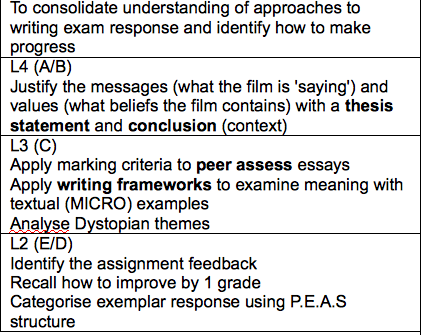
1. Peer Assess the essays you took from class today (Grace I think you left yours behind so come and collect before next Thursday). Use the mark scheme to give it a grade (numeric) and be prepared to justify your decision

2. Upload your photo of your PEAS cards you wrote today - this is crucial for us to use in class to compare with Children of Men

3. Now you have a conclusion for your Textual Analysis, plan your coursework essay - list 4 points you want to address that you can compare and contrast in each film

POINT (MACRO areas - youth are represented as.../our hero is motivated out of revenge/enjoys killing)
EXAMPLE (Key Scene & MICRO - how this links to the point)
ANALYSIS (Infer Meaning ie: the character/motives/how they overcome problems/are represented as..)

4. Pay for the Film Studies trip for next week - £10 to finance. See me Wednesday if you are skint.

Wednesday, 7 November 2012

Learning Outcomes 2.1

Coursework Intro & Study Proposal
Post mock essay - themes & messages/values

Essay structure


Wednesday, 17 October 2012

Suggestion of Thesis & Films for your Textual Analysis

Scott Pilgrim vs Eternal Sunshine: Narrative & Genre study in Thrillers / or/ Hyper-reality in Visual Style


Stakeland vs Twilight: the development of the Horror Genre 

Batman: Dark Knight vs 4 Lions: theme of Terrorism

Attack the Block vs Super 8: Representation of Youth 


Juno vs We need to talk about Kevin: Representation of the family/mothers


Tinker Tailor Soldier Spy vs 4, 3, 2, 1: the evolution of the Thriller Genre /or/ representation of Britain / or/ themes of Crime

The Kings Speech vs Harry Potter/Fishtank/Sket: representations of Britishness

Harry Potter vs Red State vs Submarine: Theme of coming of age dramas


Wild Bill vs True Grit: the re-imagining of the Western Genre

Suckerpunch vs Sket: voyeurism & the masculinisation of women

Heroism & Cowardice & The Absurdity/Brutality of War: Inglorious Basterds vs The Hurt Locker vs The Wind that shakes the Barley