Showing posts with label MACRO Narrative. Show all posts

Wednesday, 30 January 2013

Narrative Post Mock Workshop


Narrative
"Refers to the development of a ’story’, the roles and relationships of the characters within it, the situations and dilemmas they confront and the methods utilised for problem-solving within narratives."


1. Knowledge & understanding of MACRO Narrative = (analysis of the storytelling for some deeper meaning)

2. Application of Narrative & Genre to the chosen films demonstrating insight & depth = (analysis of meaning using storytelling) 

3. Offers a range of examples from the films chosen for response, demonstrating technical knowledge and understanding, with ability to link examples to the set question

Checklist
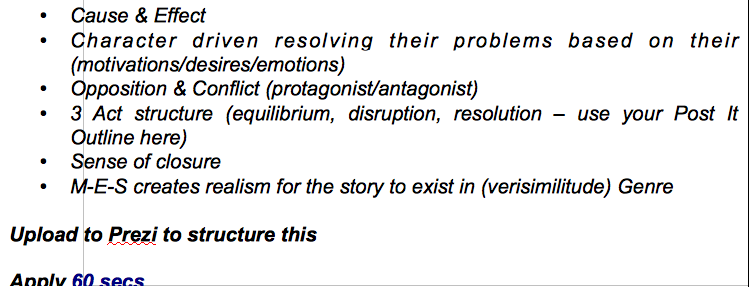
- 3 Act Structure - If it follows 3 act structure then it must have equilibrium and disruption – so analyse this, how does this motivate the heroes journey and reward – what is their reward – analysis of meaning (ie redemption?) V IS the disruption? Evey is the resolution? What is the equilibrium and why establish this as 'normal' – how does this focus our attention on the themes of the film?

- Cause/Effect – analysis of this relationship, if this is all V plan then all characters are being manipulated by him. Is this the typical hero? Why does Evey act? Why does V want revenge and how come he has superpowers

- Character driven/motivation - Theo decides to act for what reason – is he moving the plot forward or do things just happen to him? V is psychologically damaged as is Evey who he tortures. Is this typical for a hero?  

- Opposition & Conflict - clearly defined by the protagonist & antagonist. Is this the case with V - are the boundaries between who is the antagonist clear, V is manipulating everyone? Who is the antagonist in Children of Men.
- Positive Resolution & Closure – how are our protagonists rewarded for their journey? Is there a sense of closure and are we comfortable with this or is it open ended – what do you read into this and why have they left it like this? Any loose ends not tied up you are not satisfied with – what about the uprising and the state of England? What about the future of humanity? The public have been manipulate by the Norsefire party and now by V. Are they not just as sheeplike? Why does the army not open fire?

- Hybrid genres - mix together the boundaries of what type of film it is. Need sci-fi elements to establish it is set in the near fiture as technology and a bleak future 'seem' to be where we are headed

An answer – how do they relate to these concepts are they successful, why do they/don't they tell the story using CHN for what purpose?
How is the film telling the story to draw attention to its messages or themes – is it using the CHN to do this or not & why?
Are they actually very good at storytelling and why? Do the characters seem 2 dimensional and their attempts to resolve the problems overly far fetched?
How does the purpose compare for each film,
Justify = give reasons for your argument select from a

  • TO WHAT EXTENT DO THEY CONFORM (OR NOT) IN COMPARISON and
  • WHY DO THESE CONFORM OR NOT?
  • HOW SUCCESSFUL (TELLING THE STORY INTERESTINGLY, to communicate a message, to entertain)?
  • Non-Linear Narrative = Post-modern
  • Flawed characters – not heroes – more realistic, more conflicted/complex = Post-modern
  • Negative Resolution = Post-modern
  • Is there a clear protagonist & antagonist – isn't V the terrorist? Who is the conflict between in CoM and how does this link to themes?
    HOW SUCCESSFUL (TELLING CLEAR STORY & AUDIENCE ENJOYMENT)?
  • CLUNKY overly complex NARRATIVE?)
  • Is V too DENSE in the scene with the old man?
  • TOO PREDICTABLE?
  • REALISTIC PACING of events or too slow? trying to focus on the themes, meaning/messages?
  • V for Vendetta was adapted from a 3 part (episodic) comic book had to translate this way of storytelling to a film 
  • TRYING TO DO SOMETHING DIFFERENT, unpredictable
  • GENRETHRILLER: SOPHISTICATED AUDIENCE = COMPLEX MYSTERY & SUSPENSE
  • Storytelling techniques used to highlight create stronger sense of realism to focus on the messages = its a WARNING this is happening/will happen soon/could happen
  • Storytelling is typically 'mainstream' to reach a wider audience with it Messages and Themes of Dystopia to stand out/draw attention to
What is your conclusion & what key examples from the film is this coming from?
 
Analysis + Thesis Statement + Argument in the form of an answer (with list of your points)

Thursday, 20 December 2012

Cover work for Thursday 20th & Friday 21st Dec

Instructions for the day ought to be on the door. "Complete your V for vendetta and children if Men in 60 seconds. Group leaders Cara & Grace. Print out or draw characters & locations using finger puppets or use masks to act it out yourselves. Paper is in the box & scissors are on the bookshelf. Use your phones to take video and upload as a series of files to YouTube. Embed on your blog & annotate & send me link at end of lesson. see my blog for detailed instructions."

Lesson Objective
To apply understanding of Classic Hollywood Narrative & Genre to V for Vendetta & Children of Men

Task:
Complete your videos productions of "V & CoM in 60 seconds" & Genre Collage

Cara is responsible for V (this does not mean she does all the work or teaches the class)

Grace is responsible for CoM (this does not mean she does all the work or teaches the class)

Luke will oversee the work below is making progress & email me the attendance register (please...) I will be checking Grace & Cara's individual blogs tomorrow to see how the class has progressed.

Ideally you would have already have gotten this underway and have prepared for the lesson by either a: shooting some of this already;
b: story mapping the film allocated like the Dark Knight task we did last week; 
or 
c: bringing in materials to make the video with today

obviously if the alternative is 
d: did nothing whatsoever...

then this is disappointing... The result nonetheless is for you to produce your 60 second retelling of the films applying the Classic Hollywood Narrative elements you learned last week - see here for further a reminder

Step 1: Map out the Plot - the significant character-driven events/scenes making clear their cause & effect & the characters motivation - this will need to be made clear in your video. 

You only have 60 seconds so make your sure you map the key story driving points in the film & keep it simple

Step 2: Identify the Equilibrium - Disruption & Resolution or 3 Act Structure, again this should be made clear in your video

Step 3: Recreate the narrative using Masks of characters printed out or drawn, or finger puppets, or however you can creatively complete the task to re-tell the narrative of the film in 60 seconds. There are scissors & A3 paper on the bookshelf, card under the printer, pritt sticks may have to ask Art Technician. Film these on your mobile phones and post to Youtube.

MAKE SURE THE PHONE YOU FILM ON IS ABLE TO UPLOAD TO YOUTUBE BEFORE YOU START

Step 4: Embed these onto your individual blog IN ORDER of the Narrative

Step 5: Annotate the post to show your understanding of the 6 aspects of Classic Hollywood Narrative you learned on your mind maps last week - here is a reminder.

Step 6: Study the post here recapping on Genre, look through the Powerpoint then create a Moodboard of the conventions of Sci Fi from the trailers on the post:

Cara's group will focus on Mise-en-scene conventions (Props, Costumes, Locations, Visual effects) 

Grace's group will focus on conventions of typical or 'stock' characters and stories (invasion, space battles, threat of technology etc)

Finally - the most important task:

Step 7: Discuss in your groups and write a conclusion between you (1 paragraph - to what extent does V and CoM fit the typical conventions of a Sci-Fi film and Classic Hollywood Narrative & briefly justify your reasons)

Good Luck! Working in 2 teams together i would expect A Level students to be able to complete all steps & have them posted to your blog by the end of lesson 2 tomorrow (that's 4 hours of work). It is important you have completed this to be prepared for...

Homework for Christmas Holidays
Timed essay 50 minutes Mock exam 2: 
"How do the films you have studied (V & CoM) relate to the concept of Genre and Narrative?"

See mark scheme for guidance

Friday, 14 December 2012

Homework: Classic Hollywood Narrative


Create a 60 second video as above to retell V for Vendetta & Children of Men

Remember the task is to apply what you have learned about Classic Hollywood Narrative so in your video:
  • Identify and sequence the key Plot points
  • Show Equilibrium & Disruption
  • Establish character motivations
  • Show Cause effect between each plot point
  • Resolution - tie up the loose 'strands'
Cara - producer for V for Vendetta

Grace - producer for Children of Men

Make them as silly as you need to - you can use toys, cut outs, masks, costumes, gaffer tape etc - be creative & have some fun with them

Use your camera phones or see me for a video camera, you can get a Media student to edit them.

Wednesday, 21 November 2012

Textual Analysis MACRO framework definitions


Theory with a small 't' - some approaches
These critical approaches (theory with a small 't') may be helpful to explore your area - they are from A2 Media so the elders (yr13) may find this a good way to cross over with the Media exam


The Male Gaze


Wednesday, 17 October 2012

Narrative Structure: an introduction

Analysis of the Narrative Structure of Children of Men

In Children of Men, the overall story deals with a dystopian United Kingdom in the year 2027. The human race has become infertile and the world at large has fallen into a state of war and oppression. The Objective Story Throughline, therefore, centers around a problematic Situation.
 
In a Situational Throughline, you pass through four signposts - The Past, The Present, Progress, and the Future. These four items represent all the ways one can look at a situation. Don’t believe it? Try to describe a problematic situation without using one of those four terms. Close to impossible.

The order in which these four signposts appear are different for every story. They don’t have to be in the order listed above. In fact, there are a whole host of other factors that determine the order: if the story is a Tragedy, if the Main Character changes, what kind of plot device drives the story forward, etc.

In Children of Men the signposts have a very definite progression.
Children of Men - Morning Coffee

At the start we are dealing with The Present -The world mourns the murder of 18-year old “Baby Diego” - the last baby to have been born on earth. Terrorist bombings have become commonplace in the fight for immigrant rights. While the rest of the world has descended into chaos - Britain “Marches On.”

In the second act we find ourselves amongst the ruins of an abandoned and delapidated preschool as Miriam tells Theo of how the plague of infertility began (The Past). There they meet Syd who agrees to take him to the Bexhill refugee camp as faux prisoners.
Once in the refugee camp, matters change for the worse (Progress). An uprising amongst the immigrant refugees threatens the tentative stability imposed by British forces. Theo and Khee scarcely make their way to the docks as tension escalates into an all-out war.

Children of Men - To Safety

They board the boat prepared for them and row out to the buoy. And here is where the story stops.

Theo bleeds out just as the boat captained by the Human Project arrives - a boat aptly named The Tomorrow. (Future) Now, if you’re like me you were shaking your head, “No! This can’t be it!” when the credits started to roll. You wanted more story! Somehow you just felt like there was more to tell - as if there were still 20 to 30 minutes left to go.

My contention is that the filmmaker wanted to leave the story open-ended (and later, I’ll have a quote from the director himself that this is in fact, what he had intended). In this way, the filmmaker leaves it up to the audience to fill in that last blank. Will the world collapse in despair? Or will the hope of children win out?

Children of Men - Among the Soldiers 

In short, the filmmaker is leaving it up to us what the future will really be like.

But in leaving this last part out, he left most general audience members feeling frustrated and cheated. Most listeners of a story want to know “how it all turned out.” I believe that sense of frustration comes from the fact that there was still one more act to play out. If we had followed Kee onto The Tomorrow and learned what the Human Project was and what hope Kee’s baby held for the future, the story would’ve felt more complete. In fact, it would’ve been complete as all four acts would’ve been explored thoroughly.

Narrative 3: Characters & Propp

Vladimir Propp states there are seven 'spheres of action' which characters can be well .... characterized to. These spheres are catagrised as the hero, villain, donor, helper, princess (though this can be exchanged for a prince), dispatcher and false hero. Not all spheres of action are needed to be addressed for a film as its also well to note characters can portray more than one sphere and vice versa, spheres can be composed of several characters.
Vladimir Propp seven spheres of action:


Hero: Individual(s) who's quest is to restore the equilibrium.
Villain: Individual(s) who's task is to disrupt the equilibrium.
Donor: Individual(s) who gives the hero(s) something, advice, information or an object.
Helper: Individual(s) who aids the hero(s) with their set task.
Princess (Prince): Individual(s) which need help, protecting and saving.
Dispatcher: Individual(s) who send the hero(s) on their quest.
Fasle Hero: Individual(s) who set out to undermine the hero's quest by pretending to aid them. Often unmasked at the end of the film.

Narrative 2. Structure & Characters

Narrative Structure 1 Todorov

Why is Narrative not the same as story?

When you sit down to watch a film the narrative structure help defines the story. It needs to be structured to help the viewer understand the message contained within, giving the film meaning throughout. However you need to keep in mind that the narrative structure only applies to the way in which a story is told not the story itself.....meaning the narrative structure is the chronological stages or steps that progress from one to the other throughout the story.
The conventional narrative structure pointed out by Tzvetan Todorov as a rule has five stages though this can be rudimentary broken down to three stages, a beginning (state of equilibrium), middle (disruption to the equilibrium) and end (reinstate the equilibrium). What I mean by equilibrium its simply just a state of balance, normality in which the characters find them selves at the begining.

Below is Tzvetan Todorov conventional narrative structure complete with five stages:

Stage 1
A state of equilibrium is defined.

Stage 2
Disruption to the equilibrium by some action or crisis.

Stage3
The Character(s) recognition that there has been a disruption, setting goals to resolve problem.

Stage4
The Character(s) attempt to repair the disruption, obstacles need to be overcome to restore order.


Stage5
Reinstatment to the equilibrium. Situation is resolved, a conclusion is announced.

With the five stage layout the narrative becomes more comprehensive. However its essential to remember films need to be seamless as the chain of events unfold, with all the questions raised answered and all the loose ends tied up unless you want to break the conventions, induce a cliff hangar, intentionally create doubt in the minds of the audience and leave them questioning.
Even though these stages are presented here as a linear structure there is no golden rule that it has to be this way, especially if you wish to create a non-linear structure. Should you wish to you can always muddle up the chronological order and have the end at the begining. Remember a film should have clear goals with believable chararcters if its to maintain a sense of credibility and to help keep the audience captivated.

Characters & Roles V for Vendetta

Dietrich - what is this character's role and what Messages or Ideas does his story communicate?

Mr Creedy - what is this character's role and what Messages or Ideas does his story communicate?

Prothero - what is this character's role and what Messages or Ideas does his story communicate?

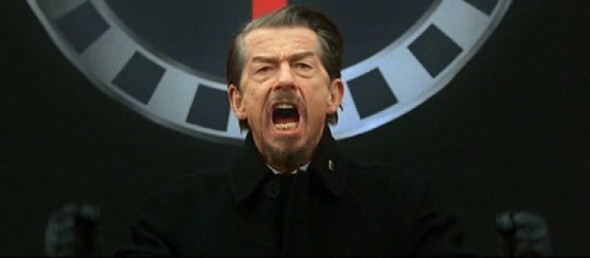
Chancellor Sutler - what is this character's role and what Messages or Ideas does his story communicate?

We the People - what their role and what Messages or Ideas does their story communicate?

V - what is this character's role and what Messages or Ideas does his story communicate?

Evey - what is this character's role and what Messages or Ideas does her story communicate?